SCIENZA
Fats on keto: which to choose and how much, without fear and without overdoing it
Published on June 15, 2026 · Updated on November 10, 2026
Published by Deketox · Editorial content for informational purposes. Sources are listed in the article and do not replace the advice of a doctor or dietitian.
On keto fats are the fuel, but not a quota to fill. Which to use as your base, which to moderate, and what research says about cholesterol.
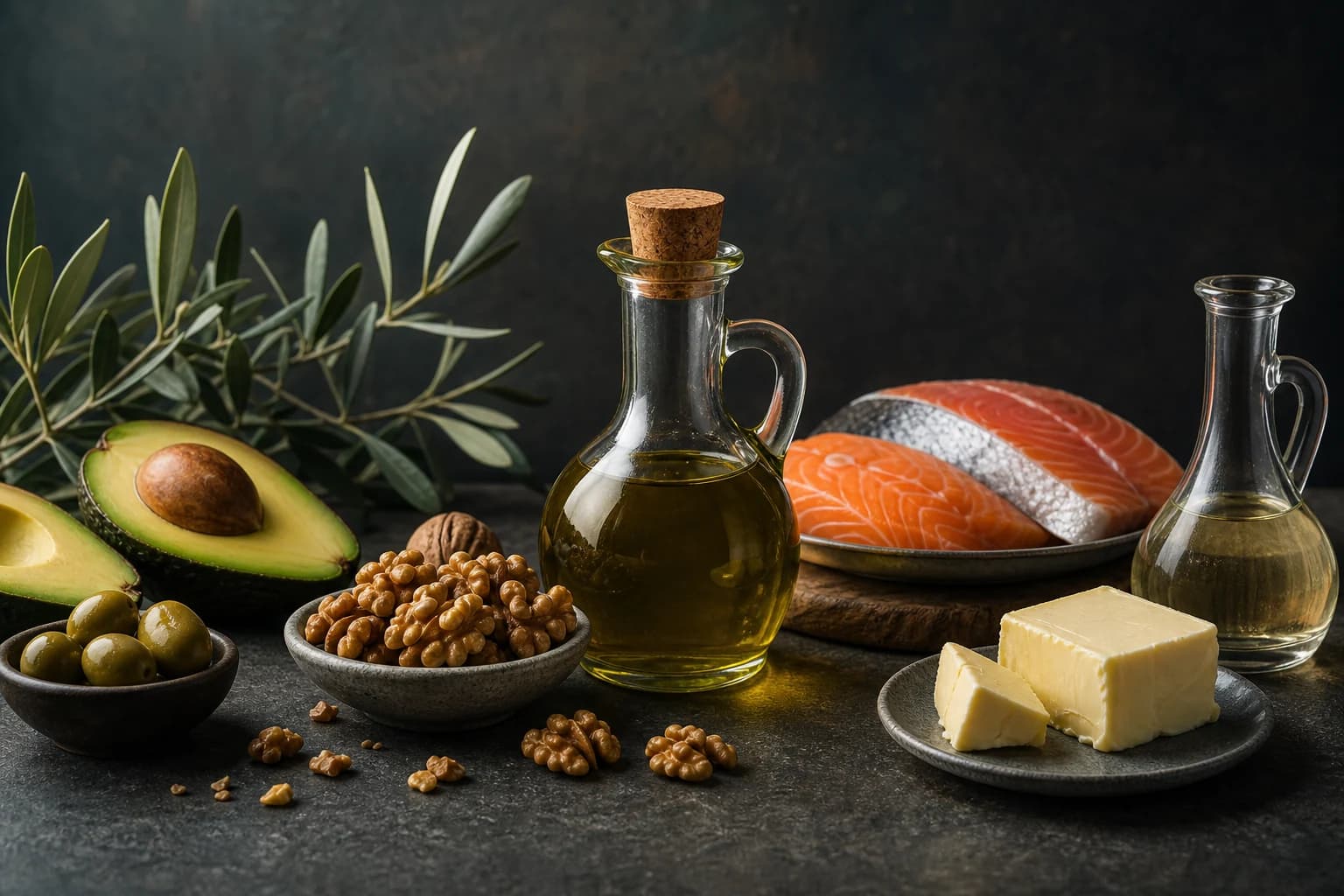
On a ketogenic diet, fats become the main source of energy. That doesn't mean "more fat = more ketosis", nor that all fats are the same. Two opposite mistakes are common: still being afraid of them, and so eating too little and badly; or adding them everywhere, in coffee, in snacks, on every plate, and wondering why the weight isn't going down.
How much fat: how to adjust the amounts
The site's macro calculator works like this: it sets the carbs (25 g net), sets the protein based on weight (1.6 g per kg), and fats make up the calories that are left.
An example: a 40-year-old woman, 70 kg, 165 cm, not very active, who wants to lose weight. The calculator estimates about 1,500 kcal a day: 25 g of carbs, 112 g of protein and about 107 g of fat.
Those 107 g are an estimate consistent with the calculated calories, which already include the reduction for weight loss. You don't need to hit them to the gram. But it helps to know how much they weigh: each gram of fat brings 9 kcal, more than double protein and carbs, and a tablespoon of oil (about 13 g) is worth about 115 kcal. Adding fat "because on keto you can" quickly shifts the day's total. If you're still hungry, look again at the amounts and make-up of your meals as a whole.
The three types of fat, with the numbers
Every fatty food contains a mix of different types. What changes is the proportion:
| Food (100 g) | Total fat | Saturated | Monounsaturated | Polyunsaturated |
|---|---|---|---|---|
| Olive oil | 100 g | about 14 g | about 73 g | about 10.5 g |
| Avocado | about 15 g | about 2 g | about 10 g | about 2 g |
| Butter | about 81 g | about 51 g | about 21 g | about 3 g |
| Coconut oil | 100 g | about 82.5 g | about 6 g | about 2 g |
Indicative values from USDA FoodData Central; the sum is a little under the total because fat also contains glycerol.
Monounsaturated: the base
Extra virgin olive oil, avocado, olives, almonds and hazelnuts. The World Health Organization points to unsaturated fats, polyunsaturated and monounsaturated from plant sources, as replacements for saturated fats. For everyday keto they're the simplest choice: extra virgin olive oil for dressing and cooking, avocado and nuts to round out meals.
Polyunsaturated and omega-3
Among the polyunsaturated fats are the omega-3s. The long-chain ones (EPA and DHA) are found mainly in oily fish:
| Fish (100 g) | EPA + DHA |
|---|---|
| Atlantic mackerel, raw | about 2.3 g |
| Farmed Atlantic salmon, raw | about 2 g |
| Sardines in oil, drained | about 1 g |
The European Food Safety Authority (EFSA) considers 250 mg of EPA and DHA a day adequate for an adult. You can reach it with one or two portions of oily fish a week, of about 150 g, depending on the species.
Walnuts and flaxseed contain another omega-3, ALA. It's useful, but the body converts only a small part of it into EPA and DHA: it isn't an equivalent source. If you don't eat fish, you can discuss microalgae supplements with your doctor.
Saturated: to moderate, on keto too
Butter, cream, cheese, fatty meat, coconut oil. In recent years you'll often have read that they've been "rehabilitated". That's not what the guidelines say: the WHO, in its 2023 update, recommends not going over 10% of calories from saturated fat and replacing it with unsaturated fat.
Applied to the example above: out of 1,500 kcal, 10% is about 17 g of saturated fat a day. A keto diet built on butter, cream and cheese easily goes over it: 30 g of butter alone gets you to about 15 g. A keto diet built on olive oil, fish, eggs and nuts stays much closer.
That's not a reason to cut out butter or cheese. It's a reason not to make them the base.
Industrial trans fats: to avoid
Industrial trans fats form when oils are partially hydrogenated, and they have the worst effect on cholesterol. Since 1 April 2021 the European Union has limited them to 2 g per 100 g of fat in foods sold to consumers. The limit doesn't cover the trans fats naturally present in animal fats, like butter and milk, which are in small amounts. If you see "partially hydrogenated oils or fats" on the label, leave it on the shelf.
Keto and cholesterol: what studies show
A ketogenic diet can raise LDL cholesterol, the kind linked to cardiovascular risk. A 2023 review in BMC Medicine, which gathered 17 meta-analyses of 68 randomised clinical trials, found high-quality evidence of an average increase of about 6 mg/dL after 12 months in adults with type 2 diabetes, compared with the control diet.
It's an average, and the response varies a lot from person to person: in some people LDL stays stable, in others the increase can be marked. There's no way to know in advance.
What to do, in practice:
- Get blood tests before you start, with a lipid profile (total cholesterol, LDL, HDL, triglycerides).
- Agree with your doctor when to repeat them.
- If LDL rises or goes above the target set for you, look together at your diet and whether to continue keto. Usually the first move is to shift fats from saturated to unsaturated: less butter, cream and cheese, more olive oil, fish and nuts.
- If you already have high cholesterol, cardiovascular disease or a strong family history, talk to your doctor before you start.
In practice
- Base: extra virgin olive oil, avocado, nuts, eggs.
- Every week: one or two portions of oily fish (mackerel, salmon, sardines).
- In moderation: butter, cream, aged cheeses, coconut oil.
- To avoid: partially hydrogenated fats.
- Amounts: fats are there to fill you up, not to hit a number. Weigh your oil for a few days: it's easy to misjudge by eye.
To see how many carbs fatty foods like nuts and dairy bring, there's the list of what to eat and what to avoid. The next step on the path is protein.
Sources:
- WHO — Saturated fatty acid and trans-fatty acid intake for adults and children (2023): saturated fat no more than 10% of calories, trans no more than 1%.
- Regulation (EU) 2019/649 on trans fats: maximum 2 g per 100 g of fat.
- EFSA — Long-chain omega-3 fatty acids (2012): 250 mg of EPA and DHA a day as adequate intake.
- Patikorn et al., Effects of ketogenic diet on health outcomes: an umbrella review, BMC Medicine, 2023.
- USDA FoodData Central (SR Legacy): fat composition and omega-3. Indicative values, they vary from product to product.
Informational and educational article; it does not constitute personalised medical or nutritional advice.
🛒 Useful products
Affiliate links: if you buy through these links we may receive a small commission, at no extra cost to you.