GUIDE
What to eat and what to avoid on the ketogenic diet: the list with the grams
Published on June 10, 2026 · Updated on November 10, 2026
Published by Deketox · Editorial content for informational purposes. Sources are listed in the article and do not replace the advice of a doctor or dietitian.
The list of yes and no foods on the ketogenic diet, with the net carbs of a real portion: on keto there are no good or bad foods, there are grams.
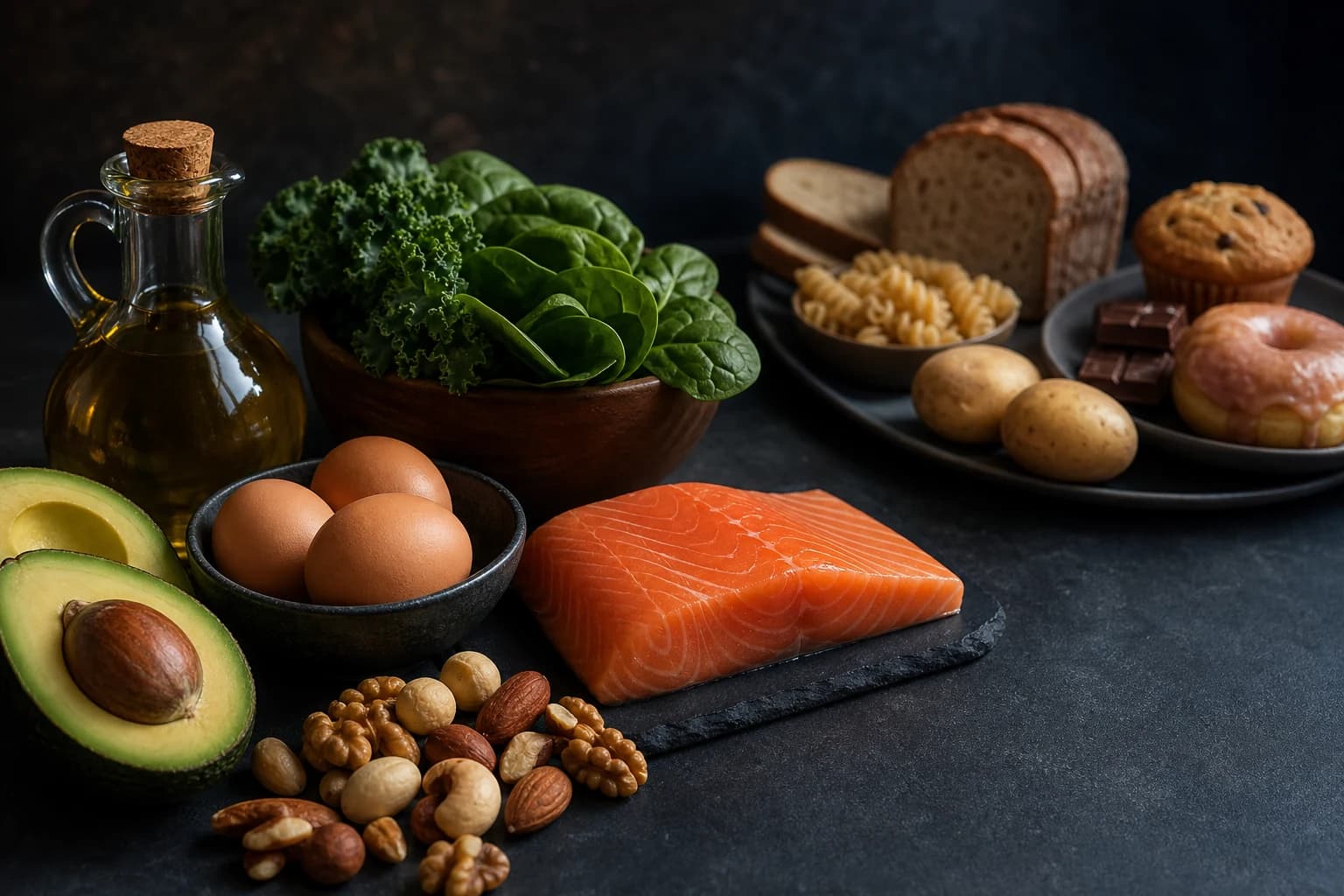
The "yes foods, no foods" lists you find online have one flaw: they put 100 g of spinach and 100 g of blueberries in the same column, and their carbs are very different. On keto there are no good or bad foods in absolute terms. There are grams of net carbs, and a portion that uses up few or many of them.
The usual reference range for keto is 20 to 50 g of net carbs a day: it's the range given, for example, by StatPearls, the clinical reference of the US National Library of Medicine. Why, and how to choose your point within the range, is in how many carbs a day on keto. This list tells you how much of that budget each food costs.
How to read the numbers
- They are net carbs, i.e. total minus fiber, taken from the same tables the site's food pages use (USDA FoodData Central). They are indicative values: the label of the product you buy always wins.
- For pasta, rice, potatoes and legumes the values refer to the cooked food.
- For drinks the values are per 100 ml.
- On European labels fiber is already excluded from carbohydrates, so it shouldn't be subtracted again there. The reason is in net carbs: how to calculate them.
Almost zero carbs
- Meat, fish and eggs. Chicken, beef, pork, salmon, mackerel, sardines, tuna, shrimp: 0 g. A medium egg (about 60 g) has less than 1 g.
- Fats and oils. Olive oil, coconut oil, butter: practically 0 g. They are high in calories, though, so the amount depends on your goal, not on keto.
- Cheese. Parmesan is at 0 g. Mozzarella, which is a fresh cheese, has about 2 g per 100 g.
The only thing to watch is processed products: sausages, hot dogs, cured meats and marinated meats sometimes contain added sugars or starches. Read the ingredients: dextrose, sucrose, starch and potato starch are carbohydrates.
Vegetables: the base of the plate, but not all the same
Vegetables are an important source of fiber on keto, and almost all of them fit the budget. The difference shows up in the portion:
| Vegetable | Net per 100 g | Net in 200 g |
|---|---|---|
| Spinach | 1.4 g | 2.8 g |
| Asparagus | 1.9 g | 3.8 g |
| Zucchini | 2.0 g | 4.0 g |
| Mushrooms | 2.3 g | 4.6 g |
| Tomato | 2.8 g | 5.6 g |
| Cauliflower | 3.0 g | 6.0 g |
| Eggplant | 3.0 g | 6.0 g |
| Bell pepper | 3.9 g | 7.8 g |
| Green beans | 4.3 g | 8.6 g |
| Broccoli | 4.4 g | 8.8 g |
Two generous plates of broccoli, 400 g in total, come to almost 18 g: on a 20 g day that's nearly all of it. It doesn't mean avoiding them, it means counting them.
To portion more carefully: onion (7.3 g per 100 g), carrots (7.2 g) and pumpkin (6.5 g). In 50 g, a sauté base or a few slices, you stay around 3-4 g.
Dairy: what counts is the milk sugar that's left
Yogurt and many aged cheeses keep less lactose than milk, but it varies from product to product: that's why the label matters.
- Full-fat Greek yogurt: 4 g per 100 g, so 6 g in a 150 g pot.
- Ricotta and cream: about 3 g per 100 g.
- Cream cheese: about 4 g per 100 g.
- Whole milk: 5 g per 100 ml, i.e. 10 g in a 200 ml glass. Best in small amounts, in coffee.
- Fruit yogurt: 13 g per 100 g, over 16 g in a 125 g pot.
Nuts and seeds: yes, but weighed
In 30 g, a handful:
| Nuts or seeds | Net in 30 g |
|---|---|
| Flaxseed | 0.5 g |
| Walnuts | 2.2 g |
| Hazelnuts | 2.2 g |
| Peanuts | 2.3 g |
| Chia seeds | 2.3 g |
| Almonds | 2.9 g |
| Pistachios | 5.2 g |
The problem isn't the handful, it's the third handful: they're easy to eat without noticing and very high in calories. Almonds have a page with the details.
Fruit: the grey area
This is where generic lists go wrong most often.
- Compatible in small portions (net per 100 g): blackberries 4.7 g, raspberries 5.5 g, strawberries 6.0 g.
- Avocado: of its 9 g of total carbs per 100 g, 6.8 are fiber, leaving 2.2 net. Its page has the details.
- Blueberries: 11.6 g per 100 g, double strawberries and raspberries. They often end up among the "berries, yes", but should be treated like an apple.
- Hard to fit in normal portions: apple and orange (about 10-12 g), grapes (17 g), banana (20 g).
What to avoid: where the budget runs out in one plate
| Food | Portion | Net |
|---|---|---|
| Pasta, cooked | 200 g | about 46 g |
| White rice, cooked | 200 g | about 55 g |
| White bread | 50 g, a thick slice | about 23 g |
| Potatoes, cooked | 200 g | about 30 g |
| Chickpeas, cooked | 150 g | about 29 g |
| Lentils, cooked | 150 g | about 18 g |
A plate of pasta on its own is more than double the budget of a strict day. For the same reason, in practice, pizza, gnocchi, polenta, crackers, breadsticks and breakfast cereals stay out.
Legumes are the case that surprises people most, because they're known as healthy food, and they are. In usual portions, like those in the table, they use up much of a day's budget; in small, counted amounts they can fit, especially at the top of the range. The lowest are edamame (3.8 g per 100 g) and peanuts, which are legumes even though they're eaten like nuts (7.5 g per 100 g).
Sugar and sweets, in practice, stay out: sugar, honey, jam, biscuits, ice cream. Very dark dark chocolate can be portioned in a few squares: in the site's data it has 19 g net per 100 g.
Drinks: the carbs you don't see
- Water, coffee, tea without sugar: 0 g.
- Sugary soft drinks: a 330 ml can of cola goes over 35 g. Even orange juice "with no added sugar" has plenty: about 20 g of carbs in a 200 ml glass, of which about 16 g are sugars.
- Zero cola: 0 g of carbs.
- Alcohol: a glass of dry red wine (150 ml) has about 4 g, a 330 ml beer about 12 g. Few carbs don't make alcohol harmless, and this isn't an invitation to drink: according to the World Health Organization there is no level of consumption that is safe for health.
Hidden carbs
These are the ones that can push up the day's total without being counted:
- Ready-made sauces and dressings: ketchup, barbecue sauces, some pestos and ready-made sauces contain sugar.
- "Light" products: some, when they remove fat, add sugar or starch.
- "Sugar-free" or "keto" products: they can contain polyols, and not all of them behave the same way on blood sugar. How to count them is explained in net carbs: how to calculate them.
For a specific food there's the carb calculator.
A counting example
Baked salmon (150 g), zucchini (200 g, weighed raw) with a tablespoon of oil, a handful of walnuts (30 g) and 100 g of strawberries to finish:
0 + 4.0 + 0 + 2.2 + 6.0 = about 12 g net
A meal with fruit included that fits even a 20 g day. The meal with pasta, on its own, is worth more than 40.
Before changing how you eat
If you take medication for diabetes or blood pressure, if you are pregnant or breastfeeding, or if you have kidney disease, talk to your doctor before starting: the cases where it really matters are in the article on ketogenic diet contraindications.
Sources:
- USDA FoodData Central (SR Legacy): the nutritional values, the same as the site's food pages. They are indicative and can vary from product to product.
- StatPearls — Ketogenic Diet, National Library of Medicine: the 20-50 g a day range.
- NIDDK — Eating, Diet & Nutrition for Lactose Intolerance: lactose in yogurt and aged cheeses.
- WHO Europe — No level of alcohol consumption is safe for our health (2023).
- Regulation (EU) 1169/2011 on nutrition labelling.
Informational and educational article; it does not constitute personalised medical or nutritional advice.
🛒 Useful products
Affiliate links: if you buy through these links we may receive a small commission, at no extra cost to you.