SCIENZA
Protein on keto: how much you really need, in grams
Published on June 15, 2026 · Updated on November 10, 2026
Published by Deketox · Editorial content for informational purposes. Sources are listed in the article and do not replace the advice of a doctor or dietitian.
How much protein to eat on the ketogenic diet: grams per kg of body weight, which foods to get it from and what research really says about protein and glucose.
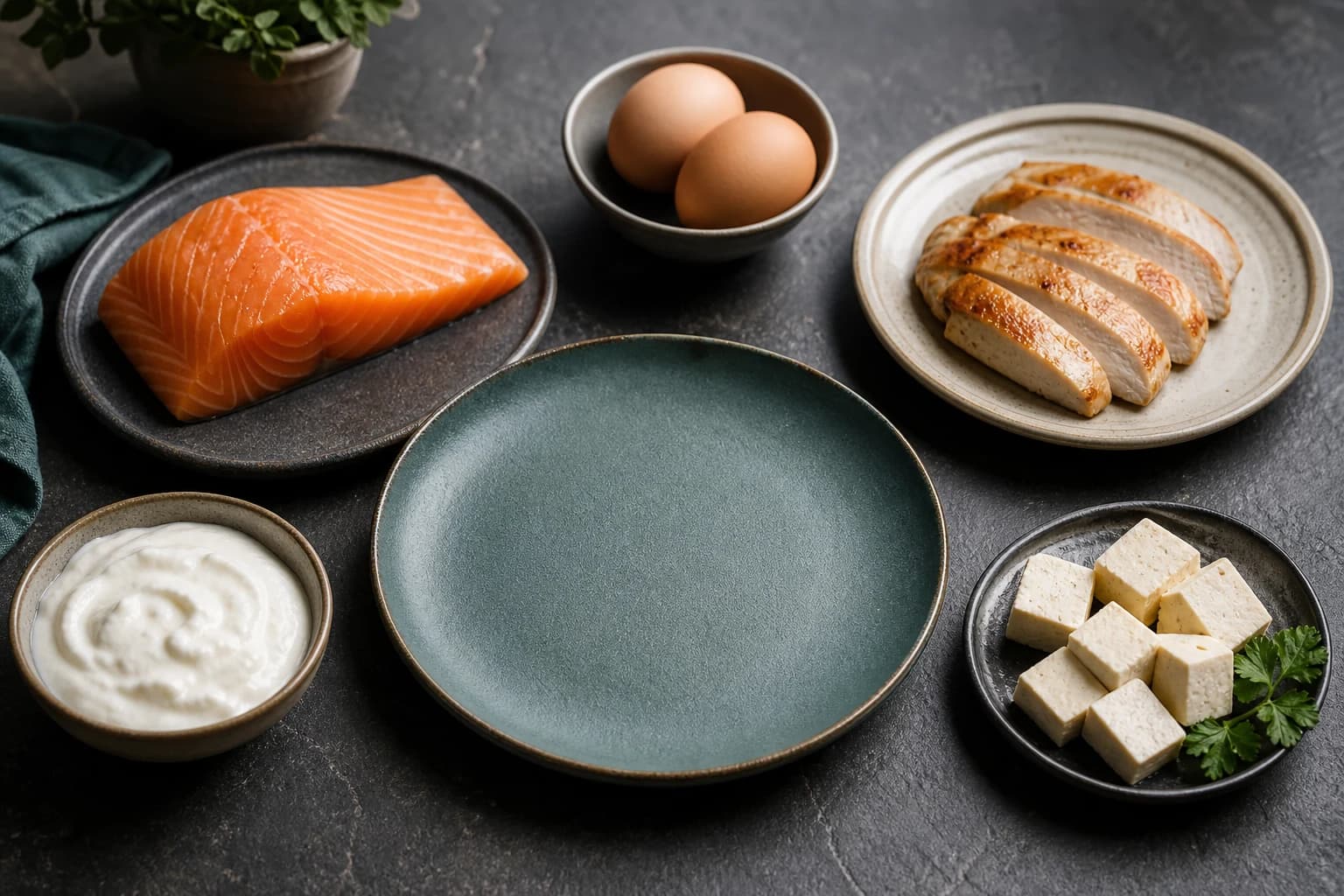
Two opposite ideas about protein on keto keep going around. The first: "keto means eating lots of meat". The second: "protein turns into sugar, so you have to keep it low". Neither holds up, and the second can push you to eat too little of it just when you're losing weight.
On a ketogenic diet the three macronutrients play different roles:
- carbs are a ceiling not to go over: the usual reference range is 20-50 g net a day, and the right point varies from person to person;
- protein is a target to reach;
- fats make up the rest of the day's energy, depending on your hunger and your goal.
How much you need: the numbers
Protein is counted in grams per kg of body weight per day. Three reference points help you get your bearings:
| Reference | g per kg a day | For a 70 kg person |
|---|---|---|
| Reference intake for adults (EFSA) | 0.83 | about 58 g |
| Weight loss with higher protein (AJCN review) | 1.2-1.6 | 84-112 g |
| Healthy people who exercise (ISSN) | 1.4-2.0 | 98-140 g |
The first number is the intake that, according to the European Food Safety Authority (EFSA), covers the needs of almost all healthy adults. It isn't designed specifically for people who are losing weight.
When you cut calories to lose weight, the body can also burn some muscle. A review published in the American Journal of Clinical Nutrition indicates that diets with 1.2-1.6 g per kg can help you lose fat while better preserving lean mass, and feel less hungry. The studies aren't only about keto.
People who exercise, especially with weights, sit in the higher band: the International Society of Sports Nutrition (ISSN) considers 1.4-2.0 g per kg sufficient for most healthy, active people.
The site's macro calculator uses 1.6 g per kg: for 70 kg that's 112 g a day. It's a starting value, not a prescription.
Which weight to use in the calculation
The calculator multiplies by your current weight. With a lot of weight to lose the number gets high: at 120 kg, 1.6 g per kg comes to 192 g a day. In cases of obesity, it's the doctor or dietitian who decides which weight to base the protein estimate on. Don't swap your current weight for your goal weight on your own: the calculator also uses it to estimate calories.
"Excess protein turns into sugar": what one study says
The body can make glucose from some amino acids: it's called gluconeogenesis, and it's normal in ketosis too. That's where the idea comes from that an extra portion of meat "switches off" ketosis.
A study published in Diabetes in 2013 tried to measure it. Eight healthy volunteers ate four eggs with labelled protein, so it could be traced through the body. Over the next 8 hours they produced about 50 g of glucose, and of this only about 4 g came from the egg protein.
It's a small study, in people without diabetes and not in ketosis. It shows that, in those conditions, only a small part of the glucose produced came from the protein eaten. It doesn't say what amount of protein is compatible with ketosis, nor that you can eat it without limits. But it does help put the fear of a normal portion into perspective.
Where to get it: the portions
Protein per portion, with the values from the site's food pages (meat and fish weighed raw):
| Food | Portion | Protein |
|---|---|---|
| Chicken breast | 150 g | about 34 g |
| Salmon | 150 g | about 30 g |
| Shrimp | 150 g | about 30 g |
| Beef | 150 g | about 29 g |
| Mozzarella | one 125 g ball | about 22.5 g |
| Sardines | 100 g | about 20 g |
| Eggs | 120 g without shell, about 2 eggs | about 15 g |
| Full-fat Greek yogurt | a 150 g pot | about 13.5 g |
| Prosciutto | 50 g | about 13 g |
| Parmesan | 30 g | about 10 g |
| Almonds | 30 g, a handful | about 6 g |
Meat and fish have practically zero carbs, eggs just over 1 g net in 120 g. Dairy and nuts have some, and they need to be counted: a 150 g pot of Greek yogurt costs about 6 g of net carbs.
If you're vegetarian, the most practical bases are eggs and dairy. If you're vegan, that leaves tofu, tempeh and soy. Legumes have protein, but together with a lot of carbs: 150 g of cooked lentils give about 13.5 g of protein and about 18 g of net carbs, almost the whole budget of a strict day. Edamame does better: 150 g give about 18 g of protein with less than 6 g net.
A day close to 112 g
An example for a 70 kg person, with the calculator's target. Vegetables aren't counted:
| Meal | What | Protein |
|---|---|---|
| Breakfast | 2 eggs and 50 g of prosciutto | about 28 g |
| Lunch | 150 g of salmon, vegetables, 30 g of Parmesan | about 40 g |
| Snack | full-fat Greek yogurt, 150 g | about 13.5 g |
| Dinner | 150 g of chicken breast, vegetables | about 34 g |
| Total | about 115 g |
Notice two things. First: no meal is "a mountain of meat", the portions are normal. Second: the protein is spread across the main meals, each with roughly 25 to 40 g. For healthy people who exercise, the ISSN suggests exactly that, splitting it over the day in doses of 20-40 g per meal.
In this example, the fats come from the salmon, the eggs, the Parmesan and the oil on the vegetables.
Who needs to be careful
- Chronic kidney disease. For adults with chronic kidney disease at stages G3 to G5 not on dialysis, the international KDIGO 2024 guidelines recommend 0.8 g per kg a day, and avoiding more than 1.3 g per kg for those at risk of progression. Here the amount of protein is decided with the nephrologist, not with a calculator.
- Diabetes on medication, pregnancy and breastfeeding. Before changing how you eat you need your doctor's advice: we cover this in the article on ketogenic diet contraindications.
- Older adults. With age, muscle is lost more easily, and cutting protein to follow a diet can backfire. Frailty and loss of muscle mass need a personal plan.
In practice
- Work out your target with the macro calculator and take it as a starting point.
- Put a protein source in every main meal, with normal portions.
- Weigh your food for a few days: it's easy to misjudge by eye, in either direction.
- If you're still hungry, look again at the amounts and make-up of your meals as a whole. Weakness or loss of strength isn't necessarily down to protein: if it lasts or is severe, talk to your doctor.
To see how many carbs the foods that go with your protein cost, there's the list of what to eat and what to avoid. The next step on the path is understanding what ketosis is and how to recognise it.
Sources:
- EFSA — Population reference intakes for protein (2012): 0.83 g per kg a day for adults.
- Leidy et al., The role of protein in weight loss and maintenance, American Journal of Clinical Nutrition, 2015: 1.2-1.6 g per kg during weight loss.
- Jäger et al., ISSN Position Stand: protein and exercise, Journal of the International Society of Sports Nutrition, 2017: 1.4-2.0 g per kg and 20-40 g per meal.
- Fromentin et al., Dietary proteins contribute little to glucose production, Diabetes, 2013.
- KDIGO 2024 Clinical Practice Guideline for Chronic Kidney Disease, Kidney International, 2024.
- StatPearls — Ketogenic Diet, National Library of Medicine: the 20-50 g of carbs a day range.
- Nutritional values: estimates from the site's food archive, based on standard tables (USDA FoodData Central, CREA). They are indicative and vary from product to product.
Informational and educational article; it does not constitute personalised medical or nutritional advice.
🛒 Useful products
Affiliate links: if you buy through these links we may receive a small commission, at no extra cost to you.