SCIENZA
What sugars (carbohydrates) are: the simple guide
Published on June 16, 2026
Carbohydrates, carbs and sugars are the same thing. What they are at the molecular level, the difference between simple and complex sugars, and why 'slow-release' doesn't mean harmless.
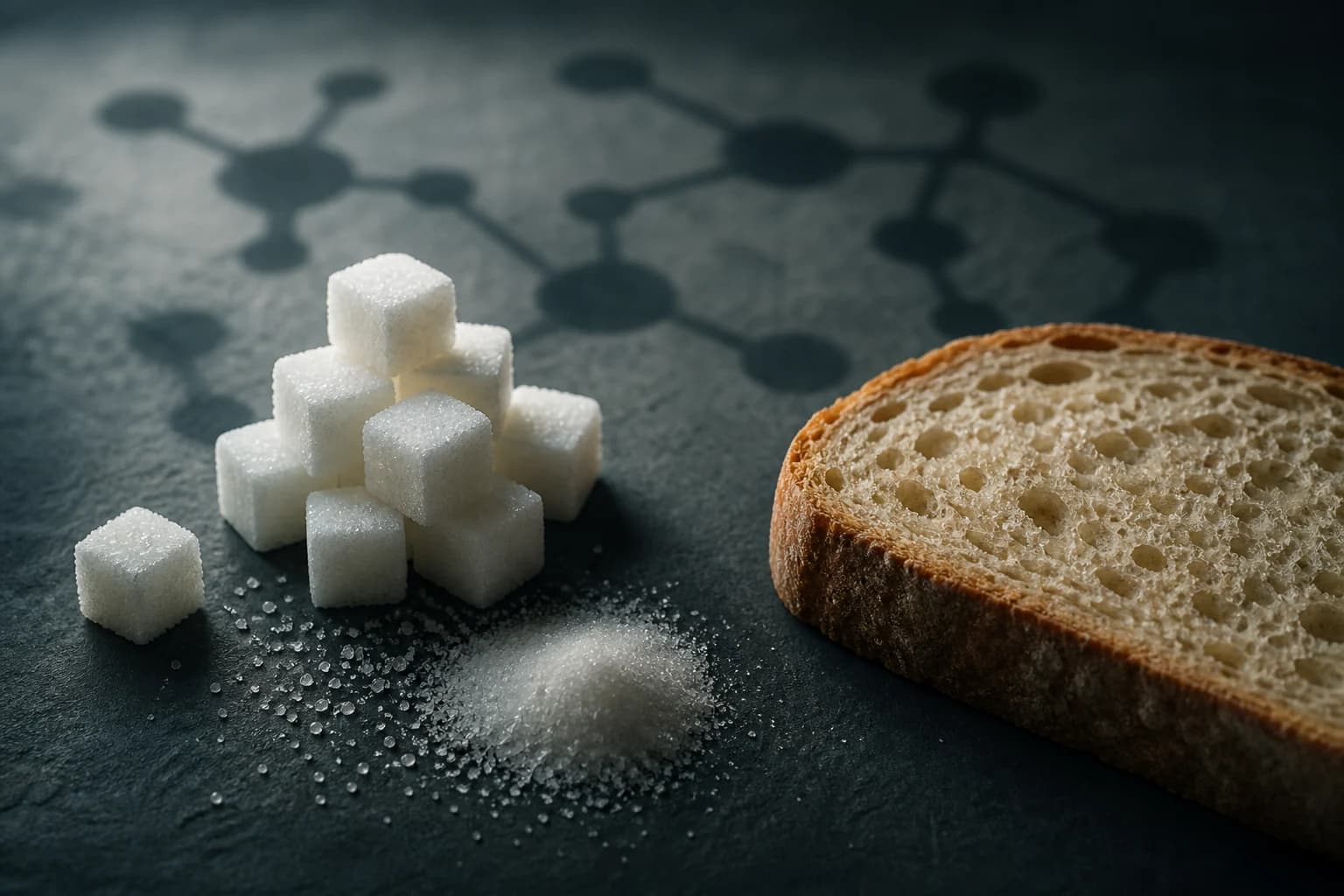
You often hear: "I don't eat sugar, I eat pasta and bread." It's a phrase born of a widespread misunderstanding: pasta, bread, rice and potatoes are sugar, just in a different form. Many people don't realize that the word "carbohydrate" and the word "carb" mean the same thing — and that, in the end, everything comes back to one molecule: glucose.
This guide sets things straight, in a simple way.
Carbohydrates = carbs = sugars
They are three words for the same family of nutrients:
- Carbohydrate is the scientific term (from the Greek glykys, "sweet").
- Carbohydrate literally means "hydrate of carbon," because they are made of carbon + water.
- Sugars is the everyday name.
So when you read "carbohydrates" on a label, you're reading "sugars" in the broad sense.
What they're made of
Every carbohydrate is built from just three types of atoms: carbon (C), hydrogen (H) and oxygen (O). The basic building block is a single sugar molecule, called a monosaccharide (from mono = one, saccharide = sugar).
The most important monosaccharide is glucose (formula C₆H₁₂O₆): it's the "fuel" your cells burn for energy, and it's what blood sugar measures.
All the other sugars are nothing more than these building blocks put together: two, or thousands.
Simple sugars: one or two molecules
They're called "simple" because they're made of very few building blocks. They fall into two groups.
Monosaccharides — 1 molecule only
- Glucose — the energy sugar par excellence; it's the one in blood sugar.
- Fructose — the sugar in fruit and honey; it's handled mainly by the liver.
- Galactose — a building block rarely found on its own; it appears mostly joined to others (in milk).
Disaccharides — 2 molecules joined
A disaccharide is simply two monosaccharides linked together. Here's the "family":
| Sugar | Made of | Where it's found |
|---|---|---|
| Sucrose | glucose + fructose | table sugar |
| Lactose | glucose + galactose | milk |
| Maltose | glucose + glucose | grains, malt, beer |
Notice one thing: ordinary white sugar (sucrose) is half glucose and half fructose. That's why "sweet" and "blood sugar" are close relatives.
Complex sugars: thousands of molecules
This is the heart of the misunderstanding. Complex sugars (or polysaccharides) are chains of hundreds or thousands of glucose molecules linked one after another.
These chains can be:
- linear, like a straight string (e.g. amylose);
- branched, like a tree with many branches (e.g. amylopectin and glycogen).
When you eat a starchy food, the digestive enzymes (like amylase, already present in saliva) have to cut the chain one bond at a time until the individual glucose molecules are freed. This work takes time: that's why starches are called "slow-release" — glucose enters the blood more gradually than a teaspoon of sugar, which is already ready to go.
Examples of complex sugars:
- Starch — bread, pasta, rice, potatoes, grains, legumes. It's glucose "packed up."
- Glycogen — the form in which your body stores glucose in the muscles and liver (the "reserve").
- Cellulose — the structure of plants: it's fiber.
"Slow-release" doesn't mean "harmless"
This is the point that almost nobody explains: however slow it is, the digestion of starch always ends with glucose in the blood. A plate of pasta isn't "sweet," but the body turns it into glucose exactly the way it would with sugar — just a bit more slowly.
That's why the ketogenic diet also limits bread, pasta and rice, not just sweets: what counts is the total carbs, not how "sweet" a food tastes. You can check it yourself with the carb calculator and see the real glycemic impact of foods.
Fiber: the carbohydrate we don't digest
Fiber (like cellulose) is a polysaccharide, but we don't have the enzymes to break it down. The result: it doesn't raise blood sugar, it feeds the gut microbiota and slows the absorption of other sugars.
This is where the idea of net carbs comes from:
Net carbs = total carbs − fiber
How much sugar per day?
The main health authorities give clear limits on free sugars (added ones + those in juices and syrups):
- WHO: less than 10% of daily calories, ideally under 5% — about 25 g a day for an adult.
- American Heart Association: a maximum of about 6 teaspoons (25 g) for women and 9 teaspoons (36 g) for men.
To get a concrete idea: 1 teaspoon ≈ 4 g of sugar (these are the "cubes" we use on the How much hidden sugar? page). A 330 ml can of cola contains about 35 g of sugar = nearly 9 teaspoons: on its own it already exceeds the recommended daily limit.
In short
- Carbohydrates, carbs and sugars are the same family.
- The simple ones (1–2 molecules): glucose, fructose, galactose, sucrose, lactose, maltose.
- The complex ones (thousands of molecules, linear or branched): starch, glycogen, fiber.
- All of them — except fiber — end up as glucose: only the speed changes.
The next step is to understand what happens when that glucose enters the blood: read glucose and insulin explained simply, then the types of carbohydrates on your plate.
Sources: World Health Organization (guidelines on free sugars), American Heart Association, nutritional biochemistry textbooks.