SCIENZA
Sweeteners on keto: which to use, how much, and what studies say
Published on June 10, 2026 · Updated on November 10, 2026
Published by Deketox · Editorial content for informational purposes. Sources are listed in the article and do not replace the advice of a doctor or dietitian.
Erythritol, stevia, sucralose, xylitol, maltitol: how much they raise blood sugar, how much you can use and what EFSA and the WHO say. With the numbers.
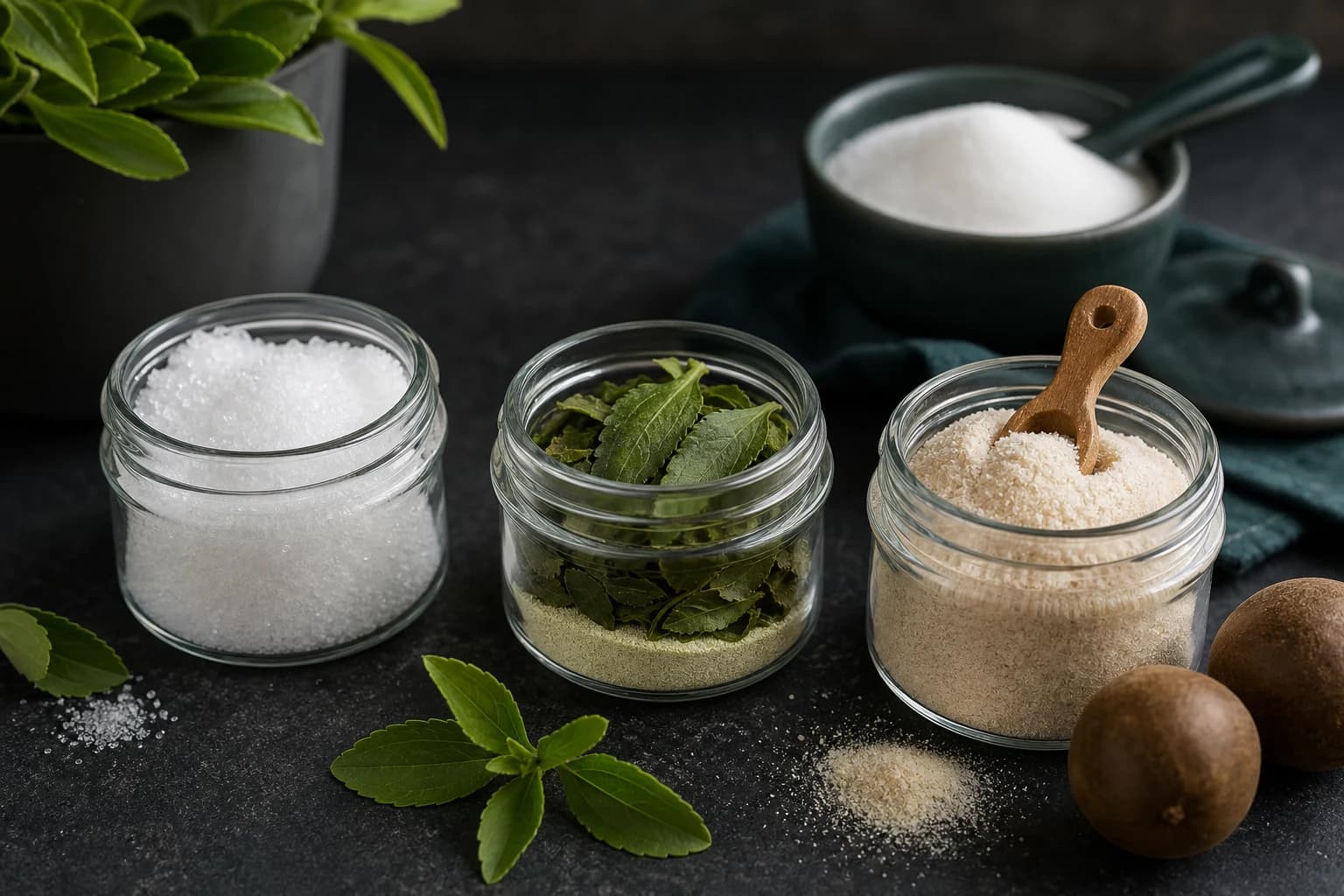
On keto, sugar stays out: a 5 g teaspoon is 5 g of carbs, and a portion of dessert can take up much of the day's carbs. The taste for sweet doesn't go away, though, and sweeteners look like the solution. They partly are. They don't all behave the same on blood sugar, some aren't even authorised in Europe, and for a couple of them there are recent studies worth knowing about.
Two different families
- Intense sweeteners: stevia, sucralose, aspartame. They're hundreds of times sweeter than sugar, so you use very little and they bring no carbs.
- Polyols: erythritol, xylitol, maltitol, sorbitol. They're less sweet, are used in amounts similar to sugar, and on the label they sit under carbohydrates, as "of which polyols". Absorption and metabolism vary from one to the next, and that's where the differences come from: erythritol, for example, is largely absorbed but excreted almost unchanged in the urine.
How much they raise blood sugar
The glycemic index measures how much a food raises blood sugar compared with glucose. Table sugar has an index of about 65. For polyols, a review published in Nutrition Research Reviews reports:
| Sweetener | Glycemic index | How to count it on keto |
|---|---|---|
| Erythritol | 0 | subtract it in full from carbs |
| Xylitol | about 13 | low, but not zero: count at least part of it |
| Maltitol | about 35 | count at least half as carbs |
| Sugar (for comparison) | about 65 | counts in full |
Pure stevia and sucralose bring no carbs and don't raise blood sugar. How to do the maths with polyols on the label is explained in net carbs: how to calculate them.
Maltitol is the one to know about. It's the most used polyol in "sugar-free" chocolate, biscuits and sweets, because it's cheap and very similar to sugar. But its glycemic index is about half that of sugar. "Sugar-free" doesn't mean low in carbs: look at the portion and count at least half of the maltitol. It's a cautious rule of thumb, not an exact calculation.
The main ones, one by one
Erythritol
It's the most used polyol on keto: glycemic index zero, and 0 kcal per gram on the label under EU rules. It has a clean, slightly "cool" taste, and is about 70% as sweet as sugar.
Two things to know:
- The dose. In 2023 EFSA, the European Food Safety Authority, set an acceptable daily intake of 0.5 g per kg of body weight, i.e. about 35 g a day for a 70 kg person. The limit is based on the laxative effect: beyond certain amounts it can cause bloating and diarrhoea.
- The 2023 study. Research published in Nature Medicine found that people with higher blood levels of erythritol had more cardiovascular events over the following three years, and that in the lab erythritol made platelets more reactive. It's an association, not proof of cause: the participants were already people at risk. The part on healthy people involved only eight volunteers, and measured how much erythritol rose in the blood after a sweetened drink, not heart attacks or thrombosis. The authors themselves call for studies on long-term safety.
In practice: these results don't show that erythritol in food causes cardiovascular events, but they don't establish a safe dose either. Using it in moderation is prudent, especially if you have cardiovascular disease or a high risk of thrombosis, and in those cases it's worth talking to your doctor.
Stevia
Stevia extracts (steviol glycosides on the label, E 960) are roughly 200 to 300 times sweeter than sugar, bring no carbs and don't raise blood sugar. EFSA sets an acceptable daily intake of 4 mg per kg of body weight, expressed as steviol and not as grams of the product on sale. It was set in 2010 and confirmed in 2024.
The limit is the taste: at high doses it leaves a bitter aftertaste, which is why it's often blended with erythritol.
Sucralose
It's an intense sweetener with no carbs. Watch out for the powdered versions "to use like sugar": to add bulk they're often padded out with maltodextrin or dextrose, which are carbs to count. Read the ingredients, not just the word "zero".
Xylitol
It has a low glycemic index and a taste very close to sugar. It has two drawbacks: it causes laxative effects more easily than erythritol, and it's highly toxic to dogs, even in small amounts. If you have a dog, keep it out of reach.
Aspartame
It brings no carbs. In 2023 the International Agency for Research on Cancer (IARC) classified it as "possibly carcinogenic" (group 2B) on the basis of limited evidence. This classification indicates a possible hazard, it doesn't measure the risk at the doses people consume: the joint FAO/WHO expert committee in fact confirmed the acceptable daily intake of 40 mg per kg. People with phenylketonuria must avoid it: that's why the label carries the warning that it contains a source of phenylalanine.
Monk fruit and allulose
On American sites they're among the most recommended keto sweeteners. In Europe the situation is different:
- Monk fruit: the concentrated extracts, the ones used as sweeteners, aren't authorised as an additive in the European Union. In 2019 EFSA concluded that the data weren't enough to assess their safety. Simple water decoctions of the fruit are a different case: since 2024 they haven't been considered a "novel food".
- Allulose: it isn't authorised in the European Union. In 2025 EFSA couldn't conclude on its safety, because the applicant didn't provide the data requested.
If you find them on sale online, check carefully what's actually on the label.
Sweeteners and weight: what the WHO says
In 2023 the World Health Organization published a conditional recommendation: don't use non-sugar sweeteners as a way to control weight. Over the long term, studies don't show a benefit on body fat. The recommendation covers intense sweeteners like stevia, sucralose and aspartame, not polyols, and it doesn't apply to people with diabetes.
For anyone on keto, the useful message is this: a sweetener helps you stay within your carbs, but it doesn't make you lose weight on its own. It's worth asking yourself whether sweet products really help you stick to your plan, or keep the cravings going. We cover this in why you crave sugar.
In practice
- To sweeten coffee, tea and yogurt: stevia or erythritol, in small amounts.
- In "sugar-free" products, look for maltitol in the ingredients: if it's there, count at least half of it.
- In "zero" powders, check there's no maltodextrin or dextrose.
- Keep polyol amounts down: gut tolerance varies from person to person. For erythritol, bear in mind the EFSA intake limit; if bloating or diarrhoea appear, cut down or stop.
- If you have cardiovascular disease, use erythritol in moderation and talk to your doctor.
- Use sweetness as a help, not a habit.
To see how many carbs a food has, there's the carb calculator.
Sources:
- Livesey, Health potential of polyols as sugar replacers, Nutrition Research Reviews, 2003: glycemic index of polyols.
- EFSA — Re-evaluation of erythritol (E 968) as a food additive (2023): acceptable daily intake of 0.5 g per kg.
- Witkowski et al., The artificial sweetener erythritol and cardiovascular event risk, Nature Medicine, 2023.
- EFSA — Steviol glycosides (2024): acceptable daily intake of 4 mg per kg, as steviol.
- EFSA — Safety of use of Monk fruit extract as a food additive (2019).
- EFSA — Safety of D-allulose as a novel food (2025).
- WHO — Use of non-sugar sweeteners: WHO guideline (2023).
- WHO/IARC — Aspartame hazard and risk assessment results released (2023).
Informational and educational article; it does not constitute personalised medical or nutritional advice.
🛒 Useful products
Affiliate links: if you buy through these links we may receive a small commission, at no extra cost to you.